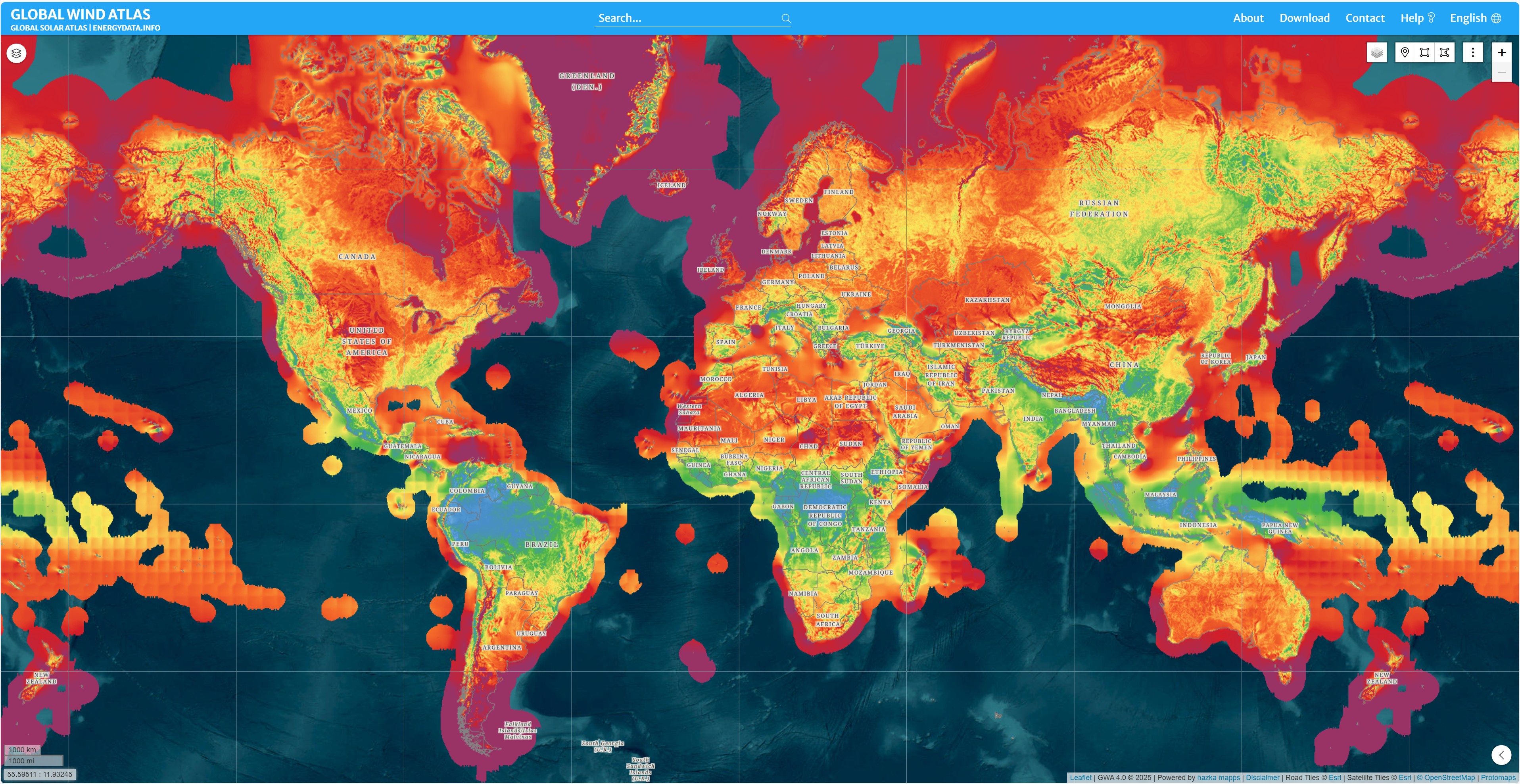
The latest release of the Global Wind Atlas contains all new data about wind resources around the world. As such, the Global Wind Atlas continues to help policymakers, planners and investors identify global, national, regional and local high-wind areas for wind power generation.
In GWA 4.0, the wind resources have been calculated even more accurately, using the best available methods and input data. GWA 4.0 features a completely new microscale modelling step, using the latest version of PyWAsP to calculate the wind resources within all the world’s country boundaries, including offshore exclusive economic zones.
The updated microscale modelling with PyWAsP uses updated air density data as well as new stability and geostrophic wind shear data from ERA5. To utilize the new data, the new stability model and the new geostrophic wind shear model were incorporated into the calculation. Furthermore, the updated microscale modelling introduces the use of tree height data from ETH Zurich, which are applied in the new displacement height model. Finally, the updated microscale modelling uses a new generalization method. All calculations use new elevation data (derived from Copernicus DEM30) and new roughness data (derived from WorldCover).
The validation of the GWA has been updated for Bangladesh, Maldives, Pakistan, Papua New Guinea, Vietnam and Zambia, and extended to include Ethiopia, demonstrating the improved accuracy of the fourth GWA dataset. More comprehensive information about the validation of GWA 4.0 can be found in the DTU report Global Wind Atlas 4 – Validation.
Finally, as part of the GWA 4.0 launch, the front-end of the GWA website has been improved, based on user research carried out by Nazka Mapps. In GWA 4.0, DTU and Nazka Mapps introduce an upgraded side panel, making it easier for users to access area data, temporal data, the energy yield calculator tool and downloads. Users might also appreciate the new transparency/opacity slider, which will help navigation while viewing GWA data layers.
The Global Wind Atlas is developed, owned and operated by DTU, Technical University of Denmark. DTU wishes to thank all organizations and individuals involved in the development of the GWA 4.0, including those not listed above, who have provided important input data, advice, review, and feedback.
The Energy Sector Management Assistance Program (ESMAP) is a partnership between the World Bank and more than 20 partnersto help low and middle-income countries reduce poverty and boost growth through sustainable energy solutions. Through the World Bank Group (WBG), ESMAP works to accelerate the energy transition required to achieve Sustainable Development Goal 7 (SDG7)to ensure access to affordable, reliable, sustainable and modern energy for all.